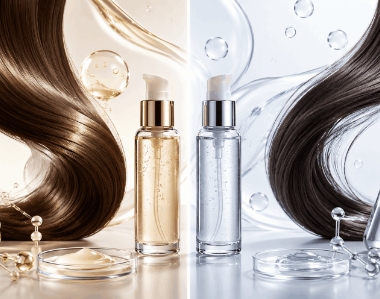
For conditioners, hair masks, leave-in creams, serums, and styling products, formulators often need to balance smoothness, shine, frizz control, spreadability, residue level, and consumer expectations. Some brands prefer proven silicone conditioning systems, while others focus on silicone free hair care supported by natural oils for hair care and other naturally derived ingredients.
When evaluating hair-care silicones, the key is to understand how ingredients such as dimethicone and cyclopentasiloxane affect conditioning, feel, and product performance. When evaluating natural oils, the focus shifts toward nourishment perception, lipid profile, sensory richness, oxidation stability, and compatibility with the full formula.
Silicones in Hair Care: Main Benefits
Silicones are widely used in hair care because they can improve the feel and appearance of hair quickly and visibly. In conditioners and leave-in products, they help reduce friction between hair fibers, improve combability, enhance shine, and control frizz.
Dimethicone is commonly used for long-lasting smoothness and conditioning. Cyclopentasiloxane is often used for a lighter, faster-spreading feel. In many formulas, different silicone types are blended to balance rich conditioning with a non-greasy finish.
Silicones are especially useful in formulas designed for damaged, dry, coarse, colored, chemically treated, or frizz-prone hair. However, the final result depends on silicone type, viscosity grade, dosage, emulsification, deposition, and compatibility with other natural hair care ingredients or synthetic conditioning materials.
Natural Oils in Hair Care: Main Benefits
Natural oils for hair care are often selected for nourishment, softness, shine, scalp care positioning, and a more botanical formulation story. Common choices include argan oil, coconut oil, jojoba oil, olive oil, sunflower seed oil, avocado oil, camellia oil, macadamia oil, and almond oil.
These oils can improve the richness of conditioners, hair masks, scalp oils, leave-in creams, and treatment serums. They also support marketing claims around plant-based care, natural origin, and softer ingredient perception.
However, natural oils vary greatly in feel and performance. Some oils feel light and dry, while others are rich and heavy. Some have better oxidation stability, while others require antioxidant support. This is why formulators should not treat all natural oils as interchangeable.
Silicone vs Natural Oils: Practical Comparison
| Comparison Point | Silicones | Natural Oils | Formulation Meaning |
|---|---|---|---|
| Main benefit | Smoothing, shine, slip, frizz control | Nourishing feel, softness, botanical positioning | Silicones are stronger for surface feel; oils support natural care concepts. |
| Hair feel | Silky, smooth, controlled | Rich, soft, sometimes heavier | Fine hair may prefer lighter systems; dry hair may tolerate richer oils. |
| Performance consistency | Usually more predictable by grade | Varies by oil type and quality | Supplier consistency matters for both systems. |
| Formulation risk | Build-up perception, regulatory review for some types | Oxidation, odor, greasiness, instability | Both require stability and sensory testing. |
| Best use | Conditioners, serums, anti-frizz products, masks | Hair oils, masks, natural conditioners, scalp products | Product positioning should guide ingredient choice. |
| Marketing fit | Performance-focused hair care | Natural, botanical, silicone-free hair care | Consumer expectation affects the best selection. |
Silicones, Natural Oils and Shampoo Systems
In shampoo and conditioner lines, the cleansing base also affects how the hair feels after use. A harsh cleansing system can make hair feel dry, even when the conditioner contains good oils or silicones. A mild and balanced surfactant system can make the entire hair care routine feel more comfortable.
For this reason, brands developing natural or silicone-free lines often evaluate the cleansing system together with conditioning ingredients. Foam, mildness, viscosity, and rinse-off behavior all matter. Ingredient choices around surfactants can strongly influence the final user experience.
When SLES is used in shampoo systems, its foam profile, compatibility, and thickening response should be considered together with oils, conditioners, and polymers. Shampoo formulas built around SLES performance may need careful balancing to avoid dryness or poor after-feel.
Ingredient Selection by Product Format
| Product Format | Suitable Direction | Why It Works |
|---|---|---|
| Rinse-off conditioner | Silicone system, oil system, or hybrid system | Can be adjusted for smoothness, richness, or silicone-free claims |
| Hair mask | Natural oils with fatty alcohols and conditioners | Supports richer texture and dry hair nourishment |
| Anti-frizz serum | Silicones or light ester-oil blends | Needs strong spreadability, shine, and frizz control |
| Scalp oil | Selected natural oils | Supports botanical positioning and scalp-care concepts |
| Leave-in cream | Hybrid system or silicone-free oil blend | Needs balance between softness and low residue |
| Shampoo | Surfactants with light conditioning support | Requires cleansing, foam, mildness, and manageable after-feel |
How to Build a Natural Hair Care Ingredient System
A successful natural hair care formula usually depends on a complete ingredient system rather than a single hero oil. Natural oils may provide softness and nourishment perception, but the final product also needs emulsifiers, thickeners, preservatives, humectants, conditioners, antioxidants, and fragrance compatibility.
For creams, lotions, masks, and conditioners, the oil phase must be properly emulsified and stabilized. Emulsifier choice affects texture, viscosity, storage stability, and rinse-off performance. In hair care products positioned as natural or silicone-free, the emulsifier and thickener system should be selected to support both performance and label expectations.
Preservation is also important because many natural-positioned products still contain water. Botanical extracts, natural polymers, and mild surfactant systems can create additional preservation challenges, so microbial safety should be evaluated early in the formulation process.