
In rinse-off hair care, foam is not the only sign of cleansing performance, but it still shapes how a shampoo is judged by both formulators and end users. This is why SLES in shampoo remains a practical topic for manufacturers, private-label brands, and ingredient buyers. Among the many cleansing materials used in hair care, sodium laureth sulfate in shampoo is widely chosen because it offers a useful balance of foam volume, wetting, detergency, and formulation flexibility. In simple terms, an SLES surfactant helps a shampoo spread quickly, lift sebum and particulate soil from the hair and scalp, and build the kind of lather that many mainstream products still require.
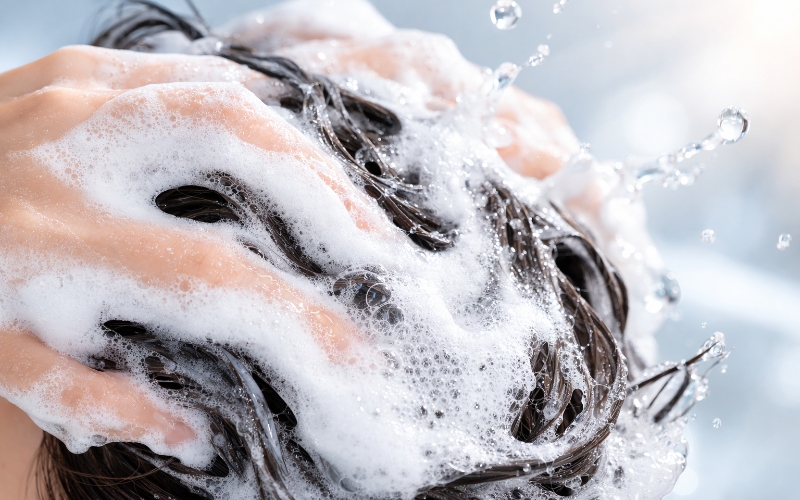
When people discuss performance, they often simplify the subject to whether a formula “foams well” or “does not foam well.” In practice, the role of SLES in shampoo is more specific. It contributes to foam generation, supports foam stability during washing, improves product distribution through wet hair, and works well with secondary surfactants used to adjust mildness and viscosity. Because of that, sodium laureth sulfate in shampoo is still a standard starting point in many everyday shampoo systems.
For readers comparing surfactant categories, our earlier articles on the difference between ionic and non-ionic surfactants and non-ionic surfactants in personal care products offer useful background. This page focuses on a narrower question: why SLES in shampoo is so often used when foaming efficiency matters.
What Is SLES and Why Is It Common in Shampoo?
SLES stands for sodium laureth sulfate, an anionic surfactant widely used in rinse-off cleansing products. As an anionic material, it lowers surface tension effectively and helps water contact oily soil more easily. That basic mechanism explains why an SLES surfactant is found in many shampoos, body washes, and facial cleansers designed for strong cleansing and rich lather.
From a formulating standpoint, sodium laureth sulfate in shampoo is attractive because it is versatile. It can generate fast foam, respond well to standard viscosity-building approaches, and combine with amphoteric or non-ionic surfactants to create milder systems. Compared with some alternative surfactants, it also gives a familiar balance between cost efficiency and performance consistency, which matters when a product is produced at commercial scale.
If you are reviewing raw material options, you can also see the related product pages for Sodium Lauryl Ether Sulfate (SLES), Sodium Lauryl Sulfate (SLS), and Cocamidopropyl Betaine (CAPB). These materials are often discussed together because the final behavior of SLES in shampoo depends not only on the primary surfactant itself, but also on what it is paired with in the formulation.
Why Foam Matters in Shampoo Formulation
Foam does not directly equal cleaning strength, but it still matters for product acceptance. In most markets, consumers expect a shampoo to lather quickly and remain easy to work through the hair during massage and rinse. That expectation is one reason sodium laureth sulfate in shampoo continues to be common. A formula that feels flat, collapses too quickly, or spreads poorly may be judged as weak even when it removes soil adequately.
How SLES Improves Foaming Performance
1. It reduces surface tension quickly
The first job of an SLES surfactant is to reduce the surface tension of water. When surface tension drops, the liquid can wet hair fibers and scalp surfaces more efficiently. Better wetting means the shampoo spreads faster and interacts more effectively with sebum, dust, and styling product residue. This fast wetting step is one reason SLES in shampoo usually gives a quick lather response during the first seconds of washing.
2. It supports rapid bubble formation
Foam forms when air is dispersed into the shampoo solution during rubbing and massaging. Because sodium laureth sulfate in shampoo lowers the energy needed to create new air-water interfaces, bubbles form more easily. This leads to visible foam with relatively little mechanical effort. In practical use, that means a shampoo built around an SLES surfactant often begins to lather earlier than systems based only on very mild, low-foam cleansers.
3. It helps maintain foam during washing
High initial foam is useful, but stable foam during the wash cycle is also important. SLES in shampoo helps create a surfactant film around air bubbles, slowing bubble collapse. The result is not just more bubbles, but foam that remains workable while the user cleanses the scalp and lengths. Full foam stability also depends on the rest of the system, including electrolytes, polymers, oils, and amphoteric co-surfactants, but this surfactant provides a strong base for that performance.
4. It balances cleansing and sensory expectations
Many high-foam systems clean well but feel overly aggressive, while some milder systems feel pleasant but underperform on heavy oil removal. An SLES surfactant often sits in the middle of that spectrum. It is strong enough to support clear cleansing performance, yet flexible enough to be moderated with ingredients such as CAPB, non-ionic surfactants, conditioning polymers, or emollients. That balance is another reason formulators keep returning to SLES in shampoo when they need reliable lather without overly complex surfactant architecture.
How SLES Works with Other Surfactants
In many shampoos, SLES is not used alone. Pairing sodium laureth sulfate in shampoo with secondary surfactants helps adjust mildness, viscosity, foam texture, and salt response. This is especially common when the target is a mainstream cleansing shampoo with a smooth and dense foam profile rather than a very sharp, airy lather.
| Ingredient | Main role in shampoo | Foam contribution | Typical formulation effect |
|---|---|---|---|
| SLES | Primary anionic cleanser | Fast foam generation and good foam volume | Provides the main cleansing and lather backbone |
| CAPB | Amphoteric co-surfactant | Improves foam creaminess and stability | Can reduce harshness and support viscosity |
| SLS | Strong anionic cleanser | High foam and strong detergency | Often used where stronger cleansing is needed |
A common combination is SLES in shampoo together with CAPB. In this type of system, SLES provides the primary cleansing and lather response, while CAPB can improve foam texture and make the system feel less harsh. Where stronger cleansing is needed, some formulators also compare sodium laureth sulfate in shampoo with SLS-based systems. The right choice depends on the desired balance among cost, mildness, viscosity, foam character, and end-use positioning.
Factors That Affect Foam Even When SLES Is Used
It is important to remember that adding more surfactant does not automatically guarantee better foam. Even a capable SLES surfactant can perform differently depending on the total formula design. Several variables matter:
Active matter level: Too low, and the shampoo may feel weak. Too high, and the formula may become difficult to optimize for mildness and viscosity.
Electrolytes: Salt can increase viscosity in many SLES systems, but too much may reduce foam quality or destabilize the formula.
Oils and silicones: Heavy conditioning components can suppress lather if they are not balanced correctly.
Water hardness: Real-use foam can change depending on calcium and magnesium levels in local water.
pH and preservatives: These do not define foam alone, but they can affect overall system stability.
For this reason, evaluating SLES in shampoo should not stop at the ingredient name on paper. Buyers and formulation teams usually need to consider specification consistency, active content, appearance, odor, compatibility with co-surfactants, and the stability of trial batches over time. When sourcing this raw material for commercial production, repeatability matters as much as lab performance.
Practical Formulation Considerations for Buyers and Manufacturers
From a sourcing perspective, the main question is often not whether an SLES surfactant can foam, but whether it can support the same foaming profile from batch to batch. In commercial manufacturing, small differences in raw material consistency may affect viscosity, clarity, fragrance compatibility, or filling efficiency. That is why procurement teams usually look beyond price alone when evaluating SLES in shampoo systems.
Useful checkpoints include technical documentation, specification clarity, supply continuity, packaging options, and communication speed during sampling or production transfer. For brands building or scaling a rinse-off line, sodium laureth sulfate in shampoo is often part of a larger sourcing decision that includes amphoteric surfactants, non-ionic surfactants, thickeners, preservatives, and fragrance compatibility support.
At TJCY, the practical value is not limited to supplying one item. For personal care ingredient buyers, the advantage is usually in coordination: product understanding, support across multiple ingredient categories, and steady communication from inquiry to shipment. For teams that need to compare SLES with related materials or discuss combinations for shampoo systems, it is often helpful to work with a supplier that can support both raw material information and broader supply planning. You can review the company profile on the TJCY homepage or reach the team through the contact page.
