Industry Information
Home > News > Industry Information > How to Build a Mild Cleansing System with SLES, APG and Cocamidopropyl Betaine
Jul. 23, 2026
A mild cleansing system is not created by choosing the weakest cleanser. It is created by distributing cleansing, foam, wetting, viscosity and sensory functions across ingredients that complement one another. A practical combination is Sodium Lauryl Ether Sulfate (SLES), an APG surfactant and Cocamidopropyl Betaine (CAPB).
SLES provides the main anionic cleansing and foam backbone. APG contributes nonionic cleansing, wetting and a milder positioning. CAPB acts as an amphoteric co-surfactant that can improve foam creaminess and help moderate the feel of the anionic base. The final result still depends on active matter, ratios, pH, fragrance, polymers and processing.
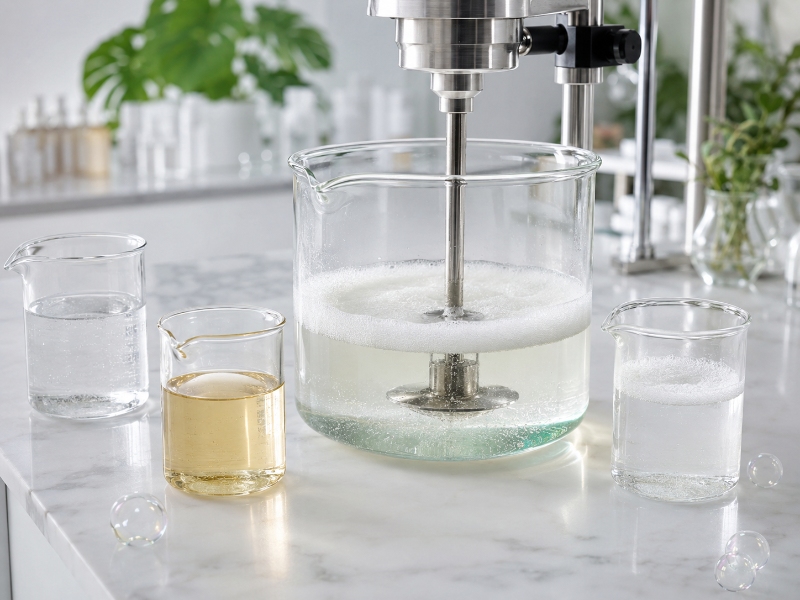
This system is useful for daily shampoos, body washes, hand cleansers and selected facial cleansers. It is a formulation framework rather than a fixed recipe: each product needs its own ratio and validation.
The three materials should be assigned clear jobs before the first laboratory batch. Overlapping functions are helpful, but treating every surfactant as interchangeable makes troubleshooting difficult.
| Ingredient | Primary role | Useful contribution | Main point to control |
|---|---|---|---|
| SLES | Primary anionic cleanser | Fast foam, detergency and reliable wetting | Total active matter, after-feel and salt response |
| APG | Nonionic co-surfactant | Mildness positioning, wetting and formulation flexibility | Foam character, clarity and viscosity behavior |
| CAPB | Amphoteric co-surfactant | Creamier foam and better system balance | Grade composition, pH and electrolyte contribution |
The most efficient way to build the system is to establish the performance backbone first and add complexity in controlled steps.
Specify the product format, target user, use frequency, foam expectation, rinse character, packaging and claim direction. A daily shampoo and a deep-cleansing shampoo should not begin with the same surfactant balance.
Use SLES for shampoo as the starting point when dependable foam and cleansing are required. Evaluate it at the intended active level, not merely by as-supplied percentage. The supplier specification should be checked before comparing laboratory batches.
CAPB is commonly used to make the foam feel denser and to improve the balance of an anionic system. Its effect is not automatic; the useful level depends on the SLES grade, total actives, pH and other ingredients.
An Alkyl Polyglucoside (APG) can support mild-cleansing or naturally positioned concepts. Add it progressively because APG may change clarity, foam texture and the way the formula responds to salt or polymeric thickeners.
Do not finalize viscosity around SLES alone and then assume the same salt curve will remain after APG and CAPB are added. Build a viscosity curve for the complete surfactant blend, then confirm behavior after fragrance, preservative and conditioning ingredients are included.
Mildness is a property of the finished system. Reducing SLES may help, but a very low-active formula can feel weak and encourage overuse. A better approach is to balance the primary cleanser with co-surfactants, control pH, avoid unnecessary electrolyte load and test the finished formula under realistic wash conditions.
For shampoo, deposition polymers, humectants and conditioning ingredients may improve after-feel, but they can also suppress foam or complicate clarity. Every improvement should therefore be assessed against cleansing, rinse, combing and stability rather than in isolation.
Formulators reviewing a wider range of surfactants for personal care applications should compare systems at equal active matter whenever possible. This produces a more meaningful assessment than comparing raw-material percentages.
Order of addition matters. Surfactants should be mixed with controlled agitation to limit aeration, and APG-containing systems may need extra attention to clarity and foam entrainment. Add salt or other viscosity modifiers gradually only after the main blend is uniform.
| Check | Why it matters | What to observe |
|---|---|---|
| pH | Affects mildness, preservative fit and ingredient compatibility | Initial value and drift during storage |
| Viscosity | Controls dispensing and consumer perception | Salt curve, temperature sensitivity and batch repeatability |
| Foam | Influences use experience | Speed, volume, density and stability in the presence of soil |
| Clarity/appearance | Reveals incompatibility or processing issues | Haze, separation, air and color change |
| Stability | Confirms commercial robustness | Room, elevated and low-temperature behavior plus packaging compatibility |
Procurement teams should compare active matter, appearance, odor, pH, microbial limits where relevant, packaging, documentation and batch consistency. The commercial formula must be adjusted when a grade or supplier changes, even if the INCI name remains the same.
TJCY supports sourcing across these surfactant categories. Buyers can review the personal care product range and share the target application, required documentation, expected order volume and destination market through the contact page.
SLES can be used in daily shampoo, but mildness depends on its active level and the complete formula. APG, CAPB, pH control and conditioning support can help create a more balanced system.
It can in some sulfate-free concepts, but the foam, viscosity, cost and sensory profile will change. Reformulation is required rather than a one-for-one replacement.
APG can change micelle structure and salt response. Rebuild the viscosity curve using the finished surfactant ratio and evaluate alternative rheology modifiers if necessary.
Provide the product type, target active matter, preferred grade, required documents, packaging, order volume and destination market. This makes technical and commercial matching more efficient.

Tianjin Chengyi International Trading Co., Ltd.
8th floor 5th Building of North America N1 Cultural and Creative Area,No. 95 South Sports Road, Xiaodian District, Taiyuan, Shanxi, China.
+86 351 828 1248 /
Navigation
