Industry Information
Home > News > Industry Information > Food Preservatives: Types, Functions, and Applications in Food Products
Aug. 10, 2026
Food preservatives play an important role in maintaining food quality, controlling spoilage, and extending the usable shelf life of packaged foods and beverages. Depending on the formulation and storage requirements, manufacturers may use different preservatives to control molds, yeasts, bacteria, or other factors that affect product stability. Buyers developing new formulations can also explore a broader range of food ingredients for different applications when evaluating preservation systems.
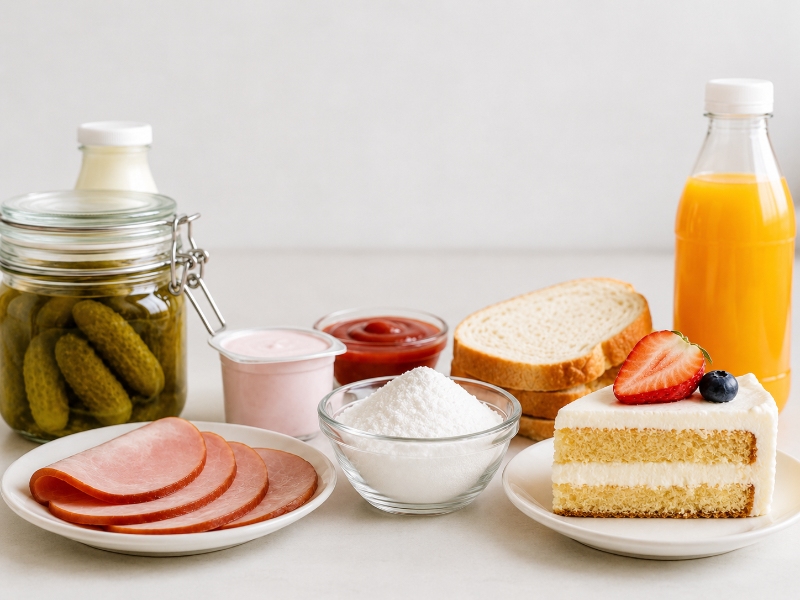
There is no single preservative that works equally well in every food product. Beverage acidity, bakery moisture, dairy composition, processing temperature, packaging, and target shelf life can all influence ingredient selection. Understanding the main food preservatives types and how they function therefore helps manufacturers build preservation strategies around the actual characteristics of the finished product.
Food preservatives are ingredients used to slow undesirable changes in food during processing, storage, and distribution. Their primary purpose may be to inhibit microbial growth, delay spoilage, or help maintain acceptable product quality over the intended shelf life.
Preservation is usually part of a wider formulation and processing system rather than a stand-alone solution. Factors such as pH, water activity, heat treatment, packaging, refrigeration, and sanitation can all affect how well a preservative performs.
As a result, food manufacturers normally select preservatives according to the food matrix and the specific deterioration risks they need to control. Common options include benzoates, sorbates, propionic acid and propionates, along with naturally derived preservation ingredients used in selected formulations.
Food preservatives can be grouped according to their chemical characteristics, source, and preservation function. In practical food manufacturing, however, the most useful distinction is often how effectively a preservative works under particular formulation conditions.
Sodium benzoate is widely used in acidic foods and beverages. Its preservation performance is closely associated with product pH, which is why it is frequently considered for carbonated drinks, fruit-based beverages, sauces, and other acidic formulations.
In beverage production, sodium benzoate is commonly used to help control yeasts, molds, and certain microorganisms that may affect stability during storage. Its effectiveness still depends on the complete beverage formulation rather than on dosage alone. The relationship between acidity and preservation performance is discussed further in this explanation of sodium benzoate in beverage preservation.
Potassium sorbate is commonly selected when mold and yeast control is an important formulation requirement. It can be used in a variety of applications, including bakery products, dairy-related products, beverages, sauces, fillings, and other processed foods.
One reason for its broad use is that it can fit into different food systems without becoming the dominant sensory component when properly formulated. In baked foods, moisture level, packaging, storage conditions, and the overall recipe still influence preservation results. Its practical use in bakery preservation systems provides a useful example of how application conditions influence preservative selection.
Propionic acid and its salts are particularly relevant to bakery preservation, where mold growth can shorten commercial shelf life. They are commonly considered for bread and other baked products that must remain stable through production, transportation, retail display, and storage.
The suitability of propionic acid depends on the food system and formulation objectives. Manufacturers need to consider factors such as pH, moisture, sensory requirements, processing conditions, and the desired shelf-life target. Understanding how propionic acid functions in food can help determine where this preservation approach is most appropriate.
Natural food preservatives have received increasing attention as manufacturers develop clean-label and naturally positioned products. Depending on the application, preservation strategies may incorporate organic acids, fermentation-derived ingredients, botanical extracts, or other naturally sourced components.
The term natural does not automatically mean that an ingredient is suitable for every formulation. Its antimicrobial spectrum, stability, flavor impact, compatibility, processing tolerance, regulatory status, and required use level all need to be evaluated in the finished food system.
The role of food preservatives extends beyond simply making a product last longer. A suitable preservation system helps manufacturers manage the major causes of deterioration while maintaining consistent quality throughout the intended distribution period.
| Preservation Function | Main Purpose | Typical Food Applications |
|---|---|---|
| Microbial Control | Helps inhibit molds, yeasts, bacteria, or other target microorganisms | Beverages, sauces, bakery and processed foods |
| Shelf-Life Support | Helps delay spoilage during storage and distribution | Packaged bakery products, beverages and ready-to-use foods |
| Quality Stability | Supports more consistent product quality over the intended storage period | Commercial packaged foods |
| Distribution Stability | Supports products exposed to longer transportation and retail cycles | Exported and widely distributed foods |
A preservative should be selected according to the preservation challenge presented by the food itself. High-moisture beverages, mold-sensitive bakery products, and dairy formulations do not have identical microbial risks or processing environments.
Beverage preservation is strongly influenced by pH, sugar content, water activity, processing method, packaging, and storage conditions. Sodium benzoate and potassium sorbate are common options in suitable beverage systems, but the final choice depends on the formulation and target microorganisms.
In bakery applications, mold growth is often one of the primary shelf-life concerns. Propionic acid or propionates and potassium sorbate may be considered depending on the recipe, product format, moisture content, packaging, and required storage period.
Dairy and processed food formulations can present more complex preservation requirements because fat, protein, moisture, pH, heat treatment, and storage temperature may interact. Preservation decisions therefore need to be evaluated together with the complete manufacturing process.
Choosing among different food preservatives types should begin with the finished product rather than with the preservative itself. Manufacturers need to identify what is most likely to limit shelf life and then evaluate ingredients that are suitable for those conditions.
Identify the food category, formulation, and target microorganisms.
Evaluate product pH, moisture, water activity, and other relevant formulation conditions.
Determine the required shelf life, packaging format, and storage environment.
Review compatibility with sweeteners, acids, stabilizers, flavors, and other ingredients.
Consider processing factors such as heating, mixing, filling, and storage.
Confirm applicable regulatory requirements and permitted use conditions in the target market.
Assess whether conventional or natural food preservatives better match the product positioning.
These considerations become particularly important when developing products for multiple markets. A formulation that performs well under one production or storage condition may require adjustment when ingredients, processing, packaging, or regulatory requirements change.
Preservatives rarely work independently of the rest of a food formulation. Acidity regulators can change the environment in which a preservative functions, hydrocolloids influence texture and water management, and sweeteners or nutritional ingredients may alter the overall formulation balance.
This is why food manufacturers increasingly evaluate preservation alongside other functional ingredients instead of treating it as a final adjustment after the product has already been developed. The same formulation approach also applies to products designed around functional food ingredients, where stability, nutrition, sensory properties, and shelf-life requirements need to work together.
Food preservatives support the safety, stability, and commercial shelf life of a wide range of food products, but the right solution depends on the formulation. Sodium benzoate is frequently associated with acidic beverages, potassium sorbate is used across several mold- and yeast-sensitive applications, and propionic acid remains particularly relevant to bakery preservation. Natural food preservatives provide additional options for manufacturers developing naturally positioned or clean-label products.
Understanding how different preservatives function, where they are commonly applied, and which formulation factors influence their performance allows manufacturers to make more informed ingredient decisions. For companies evaluating preservatives together with other food ingredients, more product and sourcing information is available through TJCY's food ingredient solutions.

Tianjin Chengyi International Trading Co., Ltd.
8th floor 5th Building of North America N1 Cultural and Creative Area,No. 95 South Sports Road, Xiaodian District, Taiyuan, Shanxi, China.
+86 351 828 1248 /
Navigation
