Industry Information
Sep. 09, 2026
Coated malic acid should be evaluated as a product format within a defined food formulation, not treated as a universal upgrade to standard malic acid. Buyers first need to confirm the exact material identity, intended food application and target market. TJCY's DL-malic acid product information provides baseline context for the uncoated food acidulant, while the wider TJCY product portfolio helps buyers locate related product categories. A coated grade requires its own technical and regulatory review.
DL-malic acid is a well-known food acidulant with characteristic lingering sourness, widely used for beverages, frozen foods and processed foods. Public datasheets list its chemical formula, CAS number and base specification table. While these baseline data support preliminary project discussion, they cannot be directly copied-and-pasted into specification sheets for coated DL-malic acid.
The term “coated / coated” only describes a product form. It does not automatically define core performance attributes: encapsulation process, wall-coating material, coating ratio, acid-release profile, particle-size distribution, dispersibility, anti-caking property and processing compatibility. All these critical parameters must be sourced from supplier’s technical documentation and verified via sample testing where necessary.
Our portfolio applies three core manufacturing processes: melt-coating, eutectic embedding and spray agglomeration. Two major wall-material series are available: lipid-based hydrogenated vegetable oil wall-materials (hydrogenated sunflower oil / hydrogenated palm oil for confectionery dusting powder), and water-soluble salt-based wall-material grades for effervescent & solid-drink systems. Different processes & wall-materials deliver distinctly different release behaviours and application boundaries.
Formulation teams turn to coated acidulants when they need to solve pain-points that regular free-flowing acid powder cannot address: moisture caking, premature chemical interaction with pigments/flavours, overly-fast sour burst, gummy sticking for dusting-powder applications.
The key question is not whether “encapsulation” sounds beneficial. It is whether the selected grade delivers expected performance inside your real-world processing workflow and food matrix.
| Buyer question | Why it matters | What to request |
|---|---|---|
| What is the complete product identity? | The coated material may not share every attribute of the base acidulant. | Product name, composition, grade, CAS reference where applicable and specification. |
| What is the coating made from? | Coating composition can affect food-use review, labeling and compatibility. | Coating-material declaration and relevant technical documentation. |
| How does the product behave during mixing? | Powder addition, dispersion and process order can influence formulation consistency. | Particle size, moisture, dispersibility guidance and application notes. |
| Which applications have been evaluated? | A result in one matrix does not prove suitability in another. | Application scope, sample data and the boundary of any supplier claim. |
Start by clarifying the exact functional role expected from coated malic acid. Is your project prioritising controlled sour-release sensory profile, anti-caking powder-handling performance, chemical isolation to avoid premature ingredient reaction, anti-stick performance for candy dusting powder, shelf-life extension — or a combination of these requirements?
Your answer will define which lab tests and supporting documents you require. It also prevents formulators from selecting coated acid merely because its product name resembles standard DL-malic acid.
Application context is equally critical:
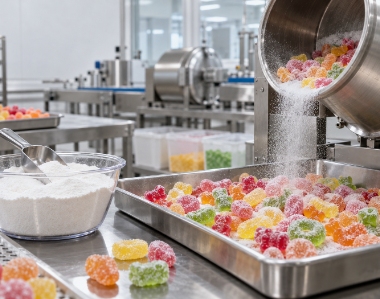
Confectionery dusting-powder workflows (sour gummies, sugar-coated candies): focus on anti-stick performance, reduction of sugar inversion, slow sour-release and powder flowability. Reference mixing ratios for gummy outer dusting powder are available for qualified customers.
Effervescent tablets & solid-drink powder systems: water-soluble coated grades shall be selected instead of lipid-coated variants.
Liquid ready-to-drink beverages: lipid-coated malic acid is not recommended, as fat-wall material will not dissolve fully in cold aqueous systems.
Buyers should keep acidulant selection separate from decisions regarding preservation, sweetening and texture-modifying agents. Do not market or document coated malic acid as a preservative, sweetener or stabiliser unless exact grade, intended function and supporting test-data fully substantiate such claims.
Public datasheets for native DL-malic acid provide only baseline reference. They can never replace the full, up-to-date technical documentation specific to your selected coated grade.
Assuming that “coated” automatically means controlled release or improved stability.
Using the specification of uncoated DL-malic acid without confirming the coated grade.
Applying a historical use level without considering the finished product and target market.
Reviewing powder appearance but not checking dispersion, sensory balance and process order.
Treating a supplier certificate or general application statement as a complete regulatory conclusion.
For buyers comparing coated malic acid options, a useful inquiry should include the product name, intended food application, target market, expected documents, packaging preference and sample requirements. This gives the sourcing team enough context to distinguish a request for standard DL-malic acid from a request for a coated grade with additional specifications.
TJCY provide coated‑acid technical support covering confectionery dusting‑powder reference formulations, effervescent‑system guidance, regulatory documentation and custom‑grade development (particle‑size, wall‑material, acid‑loading can be customised). Once your application and document requirements are confirmed, reach out to our technical team for sample evaluation and further formulation consultation.

Tianjin Chengyi International Trading Co., Ltd.
8th floor 5th Building of North America N1 Cultural and Creative Area,No. 95 South Sports Road, Xiaodian District, Taiyuan, Shanxi, China.
+86 351 828 1248 /
Navigation
