Industry Information
Home > News > Industry Information > SLES, SLS and APG: How to Choose Surfactants for Shampoo and Body Wash
Jul. 23, 2026
The SLES vs SLS decision is often presented as a simple mildness comparison, while APG is treated as a sulfate-free alternative. In practice, SLES, SLS and APG surfactants have different charge types, foam profiles, formulation behavior and commercial roles. The best choice depends on the complete shampoo or body-wash brief.
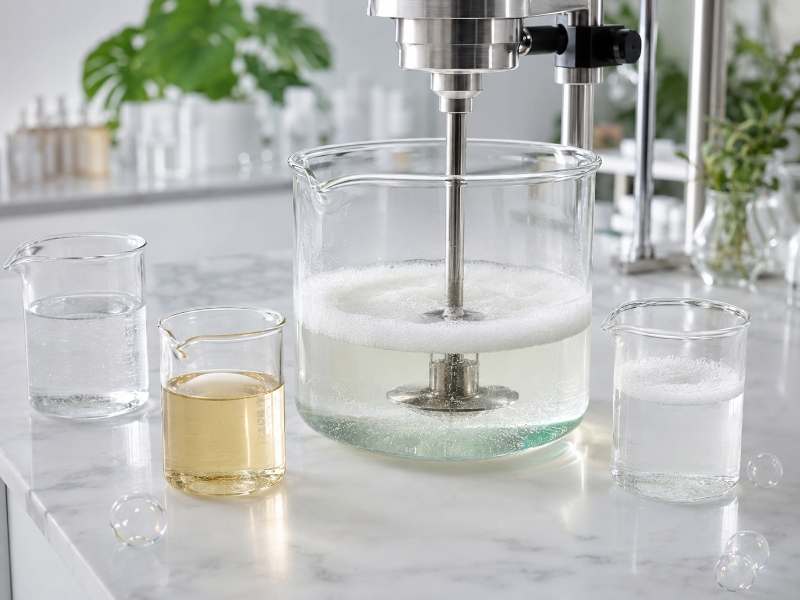
SLES and SLS are anionic surfactants that can provide efficient cleansing and abundant foam. APGs are nonionic surfactants commonly selected for milder or naturally positioned systems. They can be used alone in some concepts, but they are also valuable as co-surfactants in blended systems.
Selection should start with cleansing intensity, use frequency, target user, foam expectation, viscosity route, claim direction, cost structure and available manufacturing process. Ingredient reputation alone is not a formulation specification.
| Comparison point | SLES | SLS | APG |
|---|---|---|---|
| Type | Anionic, ethoxylated sulfate | Anionic sulfate | Nonionic alkyl polyglucoside |
| Cleansing profile | Efficient and broadly balanced | Strong and direct | Mild to moderate, grade dependent |
| Foam | Fast, abundant and easy to modify | Fast, lively and high | Often creamier or lower, system dependent |
| Mildness positioning | Usually easier to balance than SLS | Requires careful system design | Common in mild and sulfate-free concepts |
| Viscosity behavior | Often responds to conventional salt thickening | Depends strongly on form and blend | May require a different thickening strategy |
| Typical role | Mainstream shampoo/body-wash base | Strong-cleansing or simple high-foam base | Primary or supporting surfactant in mild systems |
SLES is a practical starting point for mainstream shampoos and body washes that need dependable cleansing, rapid foam and formulation flexibility. It is commonly blended with amphoteric surfactants to improve foam texture and system balance.
The advantage of SLES is not that it is automatically mild. Its value is that formulators can tune it. Pairing it with Cocamidopropyl Betaine, APG, conditioning polymers or emollients can change after-feel, viscosity and foam, but each addition must be validated in the full formula.
Choose SLES when reliable performance, scalable viscosity building and broad consumer familiarity are priorities. Review total active matter and the finished wash profile rather than relying on the raw-material percentage.
SLS can suit products that prioritize strong detergency, fast foam or a relatively direct surfactant architecture. It may be considered for deep-cleansing concepts or formats where a solid or powder-compatible anionic surfactant is useful, depending on the available grade.
The main caution is sensory balance. SLS is often perceived as more aggressive than SLES, especially in frequent-use liquid cleansers. Concentration, co-surfactants, pH and conditioning support can change the result, so the finished product—not the ingredient name—must be tested.
SLS should not be selected only because it appears simpler or cheaper. Processing, thickening, consumer positioning and claim implications can change total formulation cost.
APG surfactants are attractive for sulfate-free, mild-cleansing and naturally positioned shampoos or body washes. They provide nonionic cleansing and can broaden compatibility within a blended system.
Replacing an anionic base with APG is not a one-for-one exercise. Foam character, clarity, viscosity, fragrance solubilization and rinse feel may all change. Some APG systems require polymeric or associative thickeners rather than a conventional salt curve.
APG is a strong choice when label direction and mildness positioning are central to the brief, provided the brand accepts the necessary reformulation work and validates preservation, stability and sensory quality.
| Product brief | Recommended starting direction | Reason |
|---|---|---|
| Everyday shampoo | SLES + CAPB, optionally APG | Balances foam, cleansing, viscosity and after-feel |
| Deep-cleansing shampoo | SLES or SLS-led system | Supports stronger soil and residue removal |
| Sulfate-free shampoo | APG blended with other mild surfactants | Matches the claim while distributing performance roles |
| Mainstream body wash | SLES + amphoteric co-surfactant | Reliable foam and scalable processing |
| Mild body wash | Reduced anionic load plus CAPB/APG | Allows better control of cleansing and skin feel |
| Naturally positioned wash | APG-led blend | Supports the ingredient story, subject to claim review |
A single surfactant rarely optimizes every target. Anionic materials can provide the cleansing and foam backbone, amphoteric materials can improve balance, and nonionic materials can support mildness or a particular positioning. Blending also gives formulators more ways to tune viscosity and sensory quality.
However, more ingredients do not automatically create a better product. Every added surfactant changes micelle structure, electrolyte response, preservative environment and cost. Use the smallest system that meets the brief and create a controlled design of experiments around ratios and total active matter.
| Test area | Key question |
|---|---|
| Cleansing | Does the system remove the intended level of sebum, soil or styling residue? |
| Foam | Is lather fast, dense and stable under realistic water and soil conditions? |
| Mildness/after-feel | How does skin or hair feel after repeated realistic use? |
| Viscosity | Does the formula remain dispensable and stable across temperature? |
| Compatibility | Do fragrance, preservative, polymer, color and actives remain compatible? |
| Packaging | Does the product dispense, recover and remain stable in the final pack? |
For SLES and SLS, buyers commonly compare active matter, physical form, appearance, odor, pH and relevant impurity controls. For APG, chain distribution, active matter, appearance, color and grade-specific application fit can influence performance. In every case, compare current specifications rather than assuming all products with the same category name are interchangeable.
TJCY supplies these surfactant categories within its personal care portfolio. An effective inquiry should state the product format, target active matter, preferred claim direction, documentation, packaging, volume and destination market.
| If the priority is… | Start by evaluating… |
|---|---|
| Mainstream foam and scalable viscosity | SLES + CAPB |
| Stronger cleansing and direct high foam | SLS or an SLS-containing blend |
| Sulfate-free positioning | APG with complementary mild surfactants |
| Balanced mild-cleansing system | SLES + CAPB + APG |
| Lower formulation complexity | A focused two-surfactant system validated against the brief |
| Procurement continuity | Grades with consistent specification, documentation and supply |
SLES is generally easier to formulate into a milder-feeling liquid cleanser, but finished-product mildness depends on concentration, co-surfactants, pH and the complete formula.
APG itself is a nonionic surfactant and is not a sulfate. A finished product can only claim sulfate-free if the complete ingredient system supports that claim and local requirements are met.
Yes. It may be used as a primary or supporting surfactant, but foam, viscosity, clarity, rinse feel and conditioning compatibility should be optimized.
SLES is common in mainstream body wash, SLS may fit stronger-cleansing briefs, and APG is useful for mild or sulfate-free positioning. The best option follows the full product brief.
A common framework is SLES for the cleansing backbone, CAPB for system balance and APG for nonionic support. Exact ratios require laboratory and stability testing.

Tianjin Chengyi International Trading Co., Ltd.
8th floor 5th Building of North America N1 Cultural and Creative Area,No. 95 South Sports Road, Xiaodian District, Taiyuan, Shanxi, China.
+86 351 828 1248 /
Navigation
