Industry Information
Jul. 06, 2026
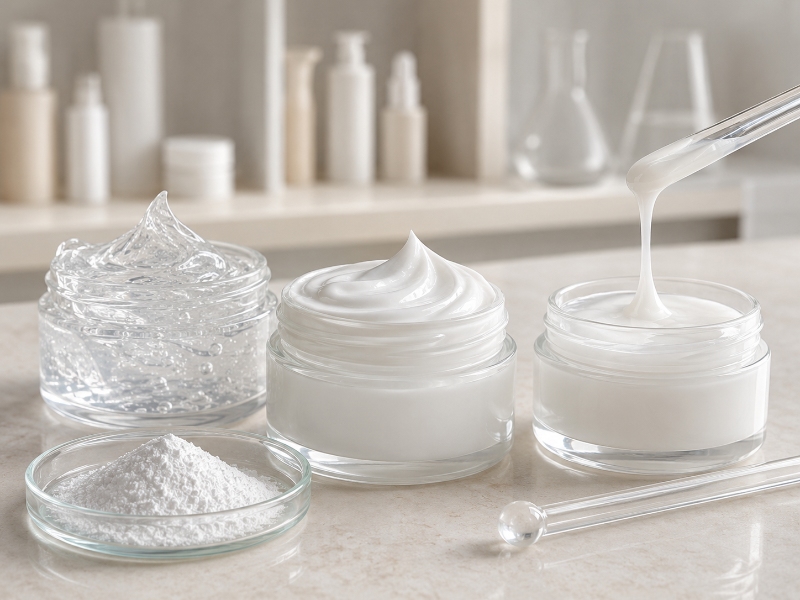
Carbomer is often described simply as a thickener, but its practical role changes with the dosage form. In a clear gel it builds the primary network. In a cream it can support the external water phase and help reduce droplet movement. In a lotion it adds controlled body while preserving pumpability and spread.
This distinction matters because a carbomer grade that gives an attractive gel may not automatically provide the best lotion flow or emulsion tolerance. Formulators should select by clarity, viscosity profile, electrolyte tolerance, processing route and sensory target, then verify the result in the complete formula.
The table is a starting framework. Finished-product behavior also depends on oil phase, emulsifier, humectants, actives, salts, fragrance, preservative and packaging.
| Format | Main carbomer role | Desired result | Frequent risk |
|---|---|---|---|
| Gel | Primary gel network and suspension | Clear, smooth structure with clean break | Clumps, air, incomplete hydration or low viscosity |
| Cream | Water-phase structure and emulsion support | Stable body and controlled spread | Electrolyte loss, poor neutralization or incompatibility |
| Lotion | Moderate viscosity and flow control | Pumpable, uniform and non-stringy texture | Over-thickening, poor recovery or temperature sensitivity |
Carbomer powder should be distributed uniformly in the water phase and allowed to hydrate. Adding neutralizer too early can lock partially wetted particles into gel lumps that are difficult to remove.
High agitation can shorten dispersion time but may entrain air. Excessive shear after the gel network develops can also affect appearance and consistency. Select mixing speed and impeller position for the batch scale.
The polymer is only one contributor to clarity. Fragrance solubilization, neutralizer choice, dissolved salts, botanical extracts and incompatible actives can create haze even when the base gel is transparent.
A cream is stabilized by the complete emulsion system. Carbomer can increase the viscosity and yield value of the continuous phase, helping slow the movement of dispersed droplets, but it does not replace a suitable emulsifier.
Add carbomer with a defined water-phase procedure, then coordinate neutralization with emulsification and cool-down additions. If the formula contains electrolytes or acidic actives, run compatibility screens early. A thick fresh batch can still lose structure during storage if the polymer is not tolerant of the final environment.
For a broader view of polymer and non-polymer options, compare rheology modifiers for personal care by their flow, suspension and sensory behavior rather than viscosity alone.
Lotions need enough structure to remain uniform but must still move through a pump and spread without excessive drag. A low apparent viscosity is not automatically better; recovery after shear and long-term stability also matter.
Evaluate the lotion in its intended package. Pump geometry, dip-tube size and repeated dispensing can expose flow problems that are not obvious in a laboratory beaker. Compare room-temperature performance with low- and high-temperature samples because viscosity can shift during distribution.
| Variable | Effect on carbomer performance | Development action |
|---|---|---|
| Dispersion | Controls clumps and hydration | Add slowly into a strong vortex without excessive air |
| Hydration time | Allows polymer particles to wet fully | Use a defined hold time before judging viscosity |
| Neutralization | Develops the gel network | Add gradually and monitor final pH |
| Electrolytes | Can reduce viscosity in sensitive grades | Screen salts and ionic actives at target levels |
| Shear and temperature | Influence structure and aeration | Replicate the intended manufacturing process |
| Order of addition | Changes local concentration and compatibility | Document and lock the successful sequence |
Before scale-up, confirm the exact grade, as-supplied form, target pH, required clarity, electrolyte load, neutralizer and mixing capability. Record both the process and the final specification so production does not rely on visual judgment alone.
Buyers should request the current specification, COA, SDS and other documents needed for their market and application. Batch consistency, packaging and lead time are part of carbomer selection because small material or process changes can be visible in the finished texture.
TJCY can support carbomer sourcing together with other personal care ingredients. For an efficient inquiry, share the dosage form, desired viscosity or flow behavior, pH range, clarity requirement, key electrolytes and destination market.
Many conventional carbomer systems develop their main viscosity after neutralization, although behavior varies by grade. Follow the supplier method for the selected material.
Sometimes, but suitability must be tested. The best grade depends on clarity, viscosity, electrolyte tolerance, emulsion system and processing.
Possible causes include pH drift, electrolyte interaction, incomplete hydration, incompatible actives, processing damage or emulsion instability. Storage testing is needed to isolate the cause.
Record an initial value, but also measure after a defined equilibration period and during stability testing. A single fresh-batch result does not establish long-term performance.

Tianjin Chengyi International Trading Co., Ltd.
8th floor 5th Building of North America N1 Cultural and Creative Area,No. 95 South Sports Road, Xiaodian District, Taiyuan, Shanxi, China.
+86 351 828 1248 /
Navigation
